The LEGO Movie was a huge success and when it aired on ITV as Warner Bros. used the ad break to their advantage. When the film stopped for an ad break, the advertisements that would have originally played seemed altered from usual. The ads took on a LEGOfied form where rather than real life with real actors, LEGO characters took their place. This was an extremely clever move by Warner Bros. because they did something that hadn't been seen before and they generated 5% more revenue onto the opening weekend revenue.
The target audience was primarily a younger demographic (12 years old and below) but it certainly stirred a sense of nostalgia within the older audiences who may have grown up with it. This nostalgic feeling couples with the sense of humour in the original adverts convey so, therefore, people may chuckle along, enjoying the entertainment as much as the film.
Emmet's representation as the hero of the story whilst also being portrayed as weak and scared is a break from the stereotype of heroes being cool and calm in the face of adversity. This promotes a good image of self as the tagline on many of the posters is: 'The story of a nobody that saved everybody'. This makes it seem as though anyone can do anything if they put their mind to it - which is a beautiful message (and it's true)!
Similarly, with the character Wyldstyle, the stereotype of being the damsel in distress is broken and she in-fact saves the main protagonist multiple times. This is a growing trend as women's rights and strength are getting more and more recognised in society so the showing of strong women to impressionable children boosts the image of women and helps young girls feel empowered.
Tuesday, 26 February 2019

Monday, 4 February 2019
Bob Marley cover - Q4
 Refer to Extract 1 in the insert. Analyse the representation of Jamaican Reggae music andmusicians such as Bob Marley in this MOJO front cover. (5 marks)
This MOJO Magazine has gone against its normal stereotypes of having very black and white colours and rock stars by featuring a full-colour picture of the reggae star Bob Marley. Bob Marley’s name is emblazed in the Jamaican colours which shows how he was very colourful and how that colour now represents reggae due to its origin. Reggae is a big influence in Jamaican culture and having Bob Marley on the front cover of MOJO Magazine shows that they respect all cultures and music.
Having Marley covering the masthead shows how important he is and makes you realise how big he is in the reggae music scene. The cover mount includes the words ‘explosion’ and ‘classics from the birth of reggae’ which connote excitement and ‘classic’ a sense of nostalgia. Rather than a stern and serious face, Marley is smiling and looking directly at the reader as if he’s happy to see them – this breaks the usual stereotype of rock icons being portrayed as serious, even saints in some. However, the magazine also keeps a bit of its stereotype with ‘BOWIE THE LOST ALBUM’ coupled with a black and white photo of Bowie looking over his shoulder.
Monday, 28 January 2019
Q4 MOJO Magazine cover and representation of artists


MOJO magazines present musicians and artists as important and powerful, often with strong and confident stances looking at the camera. They're positioned in front of the name of the magazine, implying that they're more important than the magazine itself.
The magazine has broken its usual stereotype of only having male rock icons on the cover, which shows that this woman (Joni Mitchell) has made a big impact on the music scene. The black and white colour pallet makes it seem as though Joni is part of history, engraved in music legends.
The tagline of 'The agony & ecstasy' makes it seems like she has gone through a lot to get to where she is today and that she has had failures and triumphs in her career. Her quote "My gift was born of tragedy" enforces this point as she clearly has had a hard time but it only made her stronger and better.
Tuesday, 22 January 2019
Q8 - 5 marks - Observer online
PREP
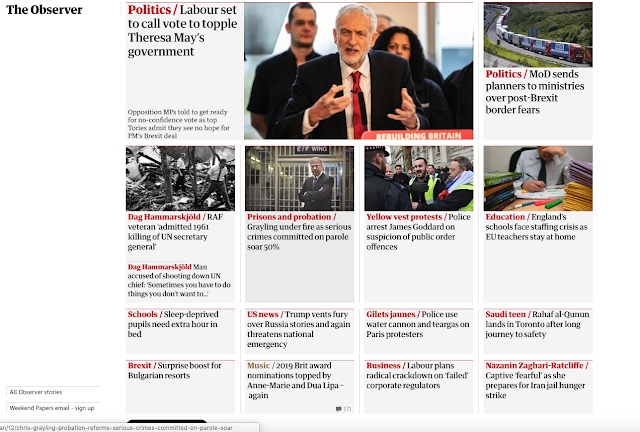
To revise the 'media language' question, you focus on the layout. It is a quick and easy question, worth 5 marks and only 2 examples needed. Please copy the question onto your blog and write the 2 examples taken from the recent Observer online. The answers below will help you.


To revise the 'media language' question, you focus on the layout. It is a quick and easy question, worth 5 marks and only 2 examples needed. Please copy the question onto your blog and write the 2 examples taken from the recent Observer online. The answers below will help you.

The use of a dark blue colour for the header connotes serious, sober and objective news. The colour blue infers a serious and formal feeling to the site and helps tell the reader that this newspaper covers hard news.
The highly ordered layout of the homepage with columns and squares making it clean and sorted, the use of white for a background and the little use of graphics and big pictures present a fresh, non-cluttered experience for users which also presents a seriousness that tells the reader that there will be hard news.
Sunday, 20 January 2019
Q9 Observer online messages and values
1. The major use of newspapers is to offer a sense of knowing what is going on in the world. The Observer knows that its readers are serious and interested in international affairs. This is evident in hard news articles about..... politics (Brexit) and protests in foreign countries (yellow vest protest in France)
2. The Observer meets its audience's need for a range of cultural, sporting and artistic news. It provides these
with... articles about music and history involving Britain
3. The Observer does not shy away from 'difficult' issues that could make uncomfortable reading, such as... the hunger strike in an Iranian jail and violent protests in France
4. The Observer has sections which are designed to appeal to different types of readers.The Observer reflects the diversity of its readership in articles on... students and education as well as foreign people like Rahaf al-Qunun
5. Newspaper readership can still be used as a symbol of one’s social identity. The term ‘Guardian reader’ connotes a certain type of social attitude and The Observer similarly reinforces a set of social and political attitudes, and thus identity, in its representations. For example, Observer readers like to think of themselves as open-minded and this is reflected in the Observer’s practice of allowing both sides of an argument equally to be put when the newspaper is clearly on one side of this argument. There is an example of this in.... the main article on the page about Brexit and how they have opinions on Brexit and the current state of the government further down

2. The Observer meets its audience's need for a range of cultural, sporting and artistic news. It provides these
with... articles about music and history involving Britain
3. The Observer does not shy away from 'difficult' issues that could make uncomfortable reading, such as... the hunger strike in an Iranian jail and violent protests in France
4. The Observer has sections which are designed to appeal to different types of readers.The Observer reflects the diversity of its readership in articles on... students and education as well as foreign people like Rahaf al-Qunun
5. Newspaper readership can still be used as a symbol of one’s social identity. The term ‘Guardian reader’ connotes a certain type of social attitude and The Observer similarly reinforces a set of social and political attitudes, and thus identity, in its representations. For example, Observer readers like to think of themselves as open-minded and this is reflected in the Observer’s practice of allowing both sides of an argument equally to be put when the newspaper is clearly on one side of this argument. There is an example of this in.... the main article on the page about Brexit and how they have opinions on Brexit and the current state of the government further down
6. The entertainment function of newspapers may take the form of humour. It may take the form of diversion into
a celebrity world of ‘glamour’. It may take the form of human interest stories in which readers are invited to sympathise with the subjects of the article. Newspapers further offer games, puzzles, crosswords and the like. At the higher end, sections such as the New Review in the Observer may offer the pleasure of extremely well-written think pieces and literature reviews. An example of this is.... the article on 'why today's leading men are driven to be buff'
Monday, 14 January 2019
Year 11 prep: Music Video Question
TD - Teenage Dirtbag
SB - Sk8er Boi
This video is documentary style mostly hand-held camerawork, de-saturated colour and fast-paced editing. - SB
This video has saturated colour, more controlled camerawork, slower-paced editing. - TD
This video consists of mostly montage shots. - SB
This video has more developed editing with cause and effect. - TD
In this video, the singer values rebellion, which is seen in the narrative. - SB
In this video, the singer values 'fitting in', conformity, albeit to an oppressive system, which is seen in the narrative. - TD
This video is set in LA, a big city, with its connotations of street credibility. - SB
The mise-en-scene of this video is American suburbia with its connotations of conformity. - TD
This video is intertextual in its narrative (=it makes references to high school drama). - TD
In this video, the singer performs to camera. - SB
In this video, real locations and 'everyday' costume for the performers connote a sense of naturalism. - SB
In this video, there is a sense of linear narrative (a story is told, in the order it unfolds). -SB & TD
SB - Sk8er Boi
This video is documentary style mostly hand-held camerawork, de-saturated colour and fast-paced editing. - SB
This video has saturated colour, more controlled camerawork, slower-paced editing. - TD
This video consists of mostly montage shots. - SB
This video has more developed editing with cause and effect. - TD
In this video, the singer values rebellion, which is seen in the narrative. - SB
In this video, the singer values 'fitting in', conformity, albeit to an oppressive system, which is seen in the narrative. - TD
This video is set in LA, a big city, with its connotations of street credibility. - SB
The mise-en-scene of this video is American suburbia with its connotations of conformity. - TD
This video is intertextual in its narrative (=it makes references to high school drama). - TD
In this video, the singer performs to camera. - SB
In this video, real locations and 'everyday' costume for the performers connote a sense of naturalism. - SB
In this video, there is a sense of linear narrative (a story is told, in the order it unfolds). -SB & TD
Thursday, 8 March 2018
QUESTION 1 CUFFS
Sound:
The cafe is busy and you can tell by the diegetic sound of people talking and the clinking of cups and plates, yet it gives off a sense of calm and normality of the situation. The PCSO's call for assistance brings in a change of mood in the relaxing and calm scene in the cafe; it brings an air of urgency. There is a wheel-screech as the JCB forklift turns into the public area. When the protagonists leave the cafe the music starts (non-diegetic) and when they start driving there is a lot of screeching, implying that they're driving at a high speed, connoting that it's urgent that they go.
I'd give myself a 3 out of 5
Tuesday, 30 January 2018
EXAM QUESTION 8
The Observer is a newspaper company who is partnered with the Guadian newspaper company. They have a website format of their newspaper counterparts which houses hundreds of stories that cover a large range of categories, all with titles that entice the reader to read on. The deep blue colours provoke an underlying feeling of seriousness and formality that shows that the news articles are going to be quite formal and serious, not exciting and about celebrities, but most likely more about crime, politics, immigration and, if really important, external affairs (what's going on in other countries). The layout of the different articles in the different categories put the most important first, making them the biggest there, and in the sports section, the top stories have pictures whereas the others don't. The layout of the articles shows which are more important or interesting, or it might just be the newest one.
The first category you will encounter is the 'features' section. These are the top stories that most people want to learn/hear about. It mainly focuses on what the popular news is at that moment in time. It ranges from crime (in this case, rape) to immigration (refugees) to things about films and celebrities. These articles may entice the reader to investigate further as some have a quote, a small description or just a title. Case in point: 'Can I forgive the man who raped me?' is a good title as it captivates the reader whilst not giving them the full picture straight away. It creates questions that the reader will want to answer, and the way of doing that is to click on the article. Take note that the article is an example of only having a title with no quote or description (however, it could be debated that the title is a quote because it's written in the first person). Another story is that the musicians 'Sleaford Mods' describes living in modern Britain. This is an example of an article with a description and quote. The quote exclaims 'There is lots of pain' which can be taken as a humorous remark, to give the reader a feeling of happiness. The article conveys a comedic message to the reader, making the reader feel good. The description explains what the article is about, providing an insight into what you're about to read as you wouldn't be able to understand what the article's about from just the vague phrase 'There is lots of pain'.
The font used is clean and clear, making it look professional and fresh. The font used for the title at the top of the page is in sans-serif as it has flattened corners that don't thin out, making it look sleek and modern. All the other titles for the articles are in standard serif form, with the serif appearing at the end of each letter. This font is reminiscent of the font used in regular newspapers. It is also widely referred to as the 'Roman' font and/or 'Gothic'. The reason sans-serif has 'sans' in front of it is because it means 'without' in French. The reason they chose the fonts was because they wanted to make it look professional and clean, whilst being reminiscent of the newspapers.
The font used is clean and clear, making it look professional and fresh. The font used for the title at the top of the page is in sans-serif as it has flattened corners that don't thin out, making it look sleek and modern. All the other titles for the articles are in standard serif form, with the serif appearing at the end of each letter. This font is reminiscent of the font used in regular newspapers. It is also widely referred to as the 'Roman' font and/or 'Gothic'. The reason sans-serif has 'sans' in front of it is because it means 'without' in French. The reason they chose the fonts was because they wanted to make it look professional and clean, whilst being reminiscent of the newspapers.
Thursday, 25 January 2018
ENIGMA SHORT FILM
Our group made a short film using the concept of enigma. The idea of our short film is that a box is delivered by a delivery man (the antagonist in disguise) to Charlie and Tom. Upon receiving the parcel, Tom and Charlie begin to look around the box, trying to find both a sender and whoever ordered it. Once they have finished going over the box, they take the box to the 'lab' where they proceed to open it. Upon opening it they discover a decapitated head, taking both by surprise. The final moments Tom exclaims something along the lines of: 'Who sent us this?' and then the camera pans to the antagonist (no longer in disguise) waving and smiling in a creepy fashion at them.
We used a number of camera angles (courtesy of myself) to make the recordings look quite cinematic. We used a tripod for most of the shots to give it a steadier pan movement and made it easier and better-looking because the camera wasn't shaking. We cut a hole out of the bottom of the box so Ben could put his head through, whilst hiding out of shot from under the tables. We also put bubble wrap around his neck to hide the hole so it looked authentic.
We used a number of camera angles (courtesy of myself) to make the recordings look quite cinematic. We used a tripod for most of the shots to give it a steadier pan movement and made it easier and better-looking because the camera wasn't shaking. We cut a hole out of the bottom of the box so Ben could put his head through, whilst hiding out of shot from under the tables. We also put bubble wrap around his neck to hide the hole so it looked authentic.
Thursday, 18 January 2018

Wednesday, 17 January 2018

Tuesday, 16 January 2018

Sunday, 14 January 2018
LEGO MOVIE POSTER ANALYSIS

Wildstyle's close-up will appeal to the female audience as she looks strong, cool and independent. She's played by Elizabeth Banks who has starred in renown films like The Hunger Games, Pitch Perfect 1 and 2 and more recently the film Power Rangers. The Power Rangers film is aimed at children as well so children may remember her name and/or recognize her voice.
Lord Business' close-up makes him appear quite menacing and frightening, showing he has a hot temper. He is played by Will Ferrell who is well-known, especially for his stellar performance in the film 'Elf'. Elf is a child's Christmas film, so people may recognize his voice and enjoy his performance in the LEGO Movie. Adults may relate to Lord Business because he just wants to have everything neat and tidy and clean, and adults may want to keep everything tidy because presumably, children leave a lot of their toys around.
Vitruvius' close-up makes him seem incredibly whimsical and wise, like most old wizard-type characters in films. His appearance is akin to well-known wizards such as Dumbledor and Gandalf and is voiced by Morgan Freeman, an actor known for playing the character 'God' in Bruce Almighty and Evan Almighty. People may just find him entertaining as he often will speak in rhyme, making his dialogue interesting and funny.
The final poster is Emmet's and it shows him with a terrified expression on his face (like seen in the full-cast poster that shows them running from an explosion, I covered this in the first paragraph). All the audience may identify with this character as he seems incredibly ordinary (except I would personally describe him as 'extraordinarily ordinary') and proves that you can do anything if you put your mind to it.
Note/edit - I'm extremely sorry this is late work; I was under the impression that I had published it even though (as I now know) it wasn't so for that I give my deepest apologies.
Friday, 12 January 2018

Friday, 5 January 2018
QUESTION 8

The film was widely received by the public with critical acclaim with many topics in it relating to everyday life; it had something for everyone, humour for adults, teenagers, and of course, the target audience, children. The video game capitalizes on the success of the film and becomes fun for all the family in the first few scenes in the game. The audiences' mind is active, making them take things in even more frequently because they are processing it.
Friday, 1 December 2017
MAGAZINE COMPARISON


These two magazine covers both feature:
- A musician covering a bit of the mast-head
- Both artists look quite confident
- Multiple different side-stories
- The main attraction has large text
- The barcode is on the front
- Both musicians are put in the center of the cover.
The differences are:
- The Billboard magazine doesn't have a puff
- The Mojo magazine has loads of side-stories whereas Billboard doesn't
- Bruno Mars covers some of his title whilst Bowie goes behind his title
- Mojo has a pug and a pull whereas Billboard doesn't
- The picture of Bowie is a low-angle shot whilst the picture of Bruno is more of a midshot
- Bowie has a gradient in the background while Bruno only has what seems to be a solid colour
Wednesday, 22 November 2017
02 MUSIC MOJO MAGAZINE 2017
Question: 'How representations on magazine covers reflect the social and cultural contexts in which they were produced'.
From classic and modern rock, folk, soul, country to reggae, electronic and experimental. It prefers to celebrate quality over popularity


A music magazine that tells/informs you about the music world.
The 'Sex Pistols' fought back against the norm of society, making outrageous songs and swearing on TV. They shocked the establishment because swearing was looked down upon and was not accepted in society.
Sunday, 12 November 2017
SK8ER BOI MUSIC VIDEO CODES AND CONVENTIONS

- Performance - the singer / band are seen to be singing and playing (including lip synching), to provide authenticity, so that followers believe in the talent and can see their star. Record labels sign stars and promote them to ensure sales. Avril Lavigne sings throughout the video using a mike and draws a huge crowd of fans around her when she jumps onto a car roof in the street. She sings with great passion, energy and conviction, holding the mike close to her mouth. Close-ups show her every word (lip synching is a feature of music videos.) She performs for her fans and for her 'boyfriend' the sk8er boi who features in the narrative. Screens often feature in music video and the sk8er boi is videoing Avril Lavigne as he gazes adoringly up at her. She returns his gaze as she sings about 'we rock each other's world'. The performance element creates authenticity (fans have proof of her talent) because we see her sing.
- Star - use of close-ups, sometimes direct eye contact with audience, to build relationship with audience. The close-ups almost seem like she's looking at you directly as she sings about this story, telling YOU the story about this girl and this 'Sk8er Boi'. At the end there is a close-up of Avril where she looks right at the camera, speaking to the Sk8er Boi directly.
- The visuals (what the star and other characters are seen doing) illustrate, amplify or contradict the lyrics (the 'story in the words'). Illustration = the visuals play out the story more or less literally; amplify = the words in the lyrics are only the starting point and the story develops in other directions; contradiction / disjuncture = the visuals do not interpret the words of the lyrics and may even show something contradictory. When Avril sings about the girl who turned down the boy sitting at home with a baby all by herself in 'five years from now' we don't get shown what she's talking about, we get told. The story is about a girl who refuses to go out with Sk8er Boi and Avril sings about the girl growing up and finding out that Sk8er Boi is now a rockstar, yet we never see anything.
- The narrative usually features the performer in 'real life' situations but often with experimental types of film making such as hand-held, dramatic camera angles, symbolic codes and lighting. There is a lot of hand-held camera angles giving the impression that they are actually being recorded for a skater-type video.
- The visuals are usually cut to the beat of the music; the editing is often fast-paced; there is often use of montage, ellipsis and intercutting, stylish effects. In the opening, the music gets straight to the beat, with Avril's gang making references and putting up advertisements for her next gig in 'seventh street & Spring' at noon. It is all very fast paced with people running around as if in time of the music because it's fast paced with fast percussion and guitar.
- Refrain - repeated chorus, sometimes with variations. The chorus is repeated multiple times and at the end it sort of ties everything together, bringing a satisfying end to the song.
- Intertextuality - references to other media, films, performances, events
Thursday, 9 November 2017
LANGUAGE IN MUSIC VIDEOS
In Wheatus' song Teenage Dirtbag the main character seems to be a typical 'uncool loser' with a crush on a girl called Noelle. His clothes are significant as they are all different to what everyone else is wearing, symbolizing that he is different. Wherever he seems to go, people make an L-shape on their hand which means they're calling him a loser, and the boyfriend of Noelle is wearing a type of clothing often associated with 'Jocks' who are generally the cool kids, showing the large contrast between the cool kids and the main character.
Tuesday, 7 November 2017
EDITING IN CUFFS

There is a scene in Cuffs where Ryan, Jake, Jo, and Carl breach the racist's house, Ryan runs straight out, pursuing the criminal whilst Jo and Carl are trying to restrain the others, leaving only Jake left, not knowing what to do. During this confrontation between Jo and Carl against the racist's friends, the camera takes the form of a POV of Jake whilst the footage gets slowed down so we have a slow-motion shot of the action taking place, alongside the voices getting muffled, possibly showing that Jake is afraid and doesn't know what he's doing.
Afterwards, we cut to Felix trying to consult with the mother of an abducted child. The mother is really distressed and we keep getting shot-reverse shot between them. As the conversation goes on, Felix continues to not make eye contact, showing that he was embarrassed by what had happened. This is quite visible with the help of this type of edit. Later we see him reviewing the video he was shown, the camera holds his face in the frame as he realizes where the abducted child is. We then cut to the screen with a slow zoom-in that shows where the kidnapper and kidnapped are.
Subscribe to:
Posts (Atom)